
Views: 0 Author: Site Editor Publish Time: 2026-08-20 Origin: Site


SUMA Combined Roller Bearings 4.053–4.063 are designed for heavy-duty linear movement where both radial and axial loads must be supported in a compact bearing arrangement. These combined roller bearings are suitable for forklifts, stackers, cranes, metallurgical equipment, container handling systems and other heavy lifting and material handling equipment.
Unlike a conventional radial bearing that primarily supports radial loads, a combined roller bearing integrates rollers working in different directions. This allows the bearing arrangement to support substantial radial and lateral loads while reducing installation space and the number of individual components.
SUMA manufactures the 4.053–4.063 combined roller bearing series for industrial customers looking for reliable replacement bearings, OEM components and custom supply solutions.
SUMA Combined Roller Bearings can be supplied in different mounting configurations to meet different equipment designs and installation requirements.
Base Plate Flange Type – suitable for applications where the bearing is mounted directly onto a supporting base plate or structural surface.
U-Profile Mounted Type – designed for installation with a U-profile structure, providing a compact and practical mounting solution.
Both configurations are available according to the customer's equipment design and installation requirements.
In heavy-duty linear equipment, the bearing does not always experience a purely radial load.
For example, a forklift mast, lifting carriage or material-handling mechanism may experience:
High vertical load
Lateral or side load
Repeated reciprocating movement
Shock loads during acceleration and stopping
Limited installation space
Continuous operation in industrial environments
Using separate radial and axial bearings can increase the number of components and require more installation space.
A combined roller bearing integrates the main rollers and side rollers into one compact assembly.
According to the SUMA technical documentation, the combined roller bearing consists of two main rollers, side rollers and shaft heads installed in different directions. This arrangement is intended to reduce space and manufacturing costs while providing relatively high radial and axial load capacity.
This makes the combined roller bearing particularly useful where a machine requires both load carrying and linear guidance.

The SUMA 4.053–4.063 series uses a multi-directional roller arrangement.
The main components include:
Main rollers → carry the primary radial load
Side rollers → control/support lateral or axial loads
Shaft heads → provide the mechanical mounting interface
The rollers operate in different directions so that the bearing can support loads generated during linear movement.
This is particularly important in forklift masts, stackers and lifting systems, where the carriage must move along a steel guide structure while maintaining controlled lateral positioning.
The SUMA documentation specifically describes the bearing as being composed of two main rollers, side rollers and shaft heads installed in different directions.
A conventional radial bearing is generally selected according to radial loading.
A combined roller bearing requires a different approach because the designer must consider the complete load vector.
For a linear lifting system, for example:
Vertical load → main radial roller
Side thrust → side roller
Combined movement → both load directions must be considered
Therefore, choosing a combined roller bearing only according to bore diameter can result in an incorrect selection.
The application load, available installation space, guide arrangement and required operating speed should also be checked.

Model | D (mm) | T (mm) | d (mm) | H (mm) | h (mm) | B (mm) | C (kN) | CO (kN) | COA (kN) | Max. RPM | Weight (kg) |
|---|---|---|---|---|---|---|---|---|---|---|---|
4.053 | 52.5 | 40 | 30 | 33.0 | 27.0 | 17 | 24.0 | 32.0 | 7 | 800 | 0.46 |
4.054 | 62.5 | 42 | 30 | 37.5 | 30.5 | 20 | 31.0 | 35.5 | 11 | 900 | 0.53 |
4.055 | 70.1 | 48 | 35 | 44.0 | 36.0 | 23 | 45.5 | 51.0 | 14 | 900 | 0.80 |
4.056 | 77.7 | 54 | 40 | 48.0 | 36.5 | 23 | 48.0 | 56.8 | 18 | 800 | 1.00 |
4.057 | 77.7 | 53 | 40 | 40.0 | 29.0 | 23 | 48.0 | 56.8 | 18 | 800 | 0.87 |
4.058 | 88.4 | 59 | 45 | 57.0 | 44.0 | 30 | 68.0 | 72.0 | 23 | 750 | 1.62 |
4.059 | 101.2 | 67 | 50 | 46.0 | 33.0 | 28 | 73.0 | 82.0 | 27 | 700 | 1.74 |
4.060 | 107.7 | 71 | 55 | 54.0 | 39.0 | 31 | 81.0 | 95.0 | 36 | 650 | 2.27 |
4.061 | 107.7 | 71 | 60 | 69.0 | 55.0 | 31 | 81.0 | 95.0 | 36 | 650 | 2.82 |
4.062 | 123.0 | 80 | 60 | 72.3 | 56.0 | 37 | 110.0 | 132.0 | 50 | 550 | 3.89 |
4.063 | 149.0 | 103 | 60 | 78.5 | 58.5 | 43 | 151.0 | 192.0 | 71 | 450 | 6.52 |
C represents the dynamic radial load rating.
CO represents the static radial load rating.
COA represents the static axial load capacity listed in the SUMA technical data.
These values should not be treated as a simple “maximum application load”. Actual bearing selection also depends on the load distribution, mating rail/profile, shock loading, operating conditions and mounting arrangement.
For a production machine, the correct model should therefore be selected from the actual operating conditions rather than simply choosing the largest bearing with the highest load rating.
For B2B OEM and replacement applications, four parameters should be considered first.
The first question is:
How much radial load does each bearing actually carry?
For example, if a lifting carriage is supported by four combined roller bearings, the total machine load should not simply be divided by four.
Uneven load distribution can occur because of:
Frame deformation
Manufacturing tolerances
Rail alignment
Load position
Center-of-gravity offset
Acceleration and deceleration
Installation tolerances
Therefore, the most heavily loaded bearing may carry substantially more than the theoretical average.
This is especially important for forklift masts, cranes and lifting equipment.
The second question is:
How much lateral force acts on the bearing?
Side loading can be generated by:
Off-center loads
Rail misalignment
Carriage movement
Structural deflection
Uneven loading
Acceleration and stopping
The side roller is therefore not simply an accessory. It plays an important role in maintaining the guided movement of the equipment.
If side loading is significant, the axial/side-load capacity must be considered when selecting the bearing.
A larger bearing generally provides greater load capacity, but it also requires more installation space.
The SUMA 4.053–4.063 series covers a range of outside diameters from approximately 52.5 mm to 149 mm, with bore sizes from 30 mm to 60 mm.
This gives engineers several options when balancing:
Load capacity ↔ mounting space ↔ shaft size ↔ system weight
For replacement projects, matching the existing dimensional envelope is particularly important.
Combined roller bearings are normally used in linear movement and material-handling equipment rather than high-speed rotating machinery.
The SUMA 4.053–4.063 series has listed maximum speeds ranging from 450 to 900 rpm, depending on model.
For example:
4.054 → up to 900 rpm
4.055 → up to 900 rpm
4.058 → up to 750 rpm
4.060 → up to 650 rpm
4.062 → up to 550 rpm
4.063 → up to 450 rpm
These figures are catalogue values and should not automatically be interpreted as the recommended operating speed for every application.
For reciprocating linear systems, acceleration, cycle frequency, lubrication and contact conditions can be more important than rotational speed alone.
The smaller models are useful when the application has a more compact installation envelope.
For example:
The 4.053 has a 52.5 mm outside diameter and 30 mm bore, with a listed radial dynamic load rating of 24 kN.
It can be considered where the machine requires a relatively compact combined roller bearing arrangement.
The 4.054 increases the outside diameter to 62.5 mm, while retaining a 30 mm bore.
Its listed radial dynamic load rating increases to 31 kN.
This can be useful when the shaft diameter remains unchanged but additional bearing capacity is required.
The 4.055 uses a 35 mm bore and 70.1 mm outside diameter, with a listed radial dynamic load rating of 45.5 kN.
The larger dimensions provide a higher load rating than the smaller models.
The selection should therefore be based on the required load and mounting dimensions rather than model number alone.
The 4.056 and 4.057 are an interesting comparison because they have the same listed:
D = 77.7 mm
d = 40 mm
C = 48 kN
CO = 56.8 kN
COA = 18 kN
Maximum speed = 800 rpm
However, their listed H/h/T dimensions and weight differ. The 4.056 is listed at 1.00 kg, while the 4.057 is 0.87 kg.
This illustrates an important point for replacement buyers:
Do not select a combined roller bearing based only on bore and outside diameter.
The installation height and other mounting dimensions also need to match.
As the bearing size increases, the listed radial load ratings also increase.
For example:
Model | Radial Dynamic C | Radial Static CO | Axial Static COA |
|---|---|---|---|
4.058 | 68 kN | 72 kN | 23 kN |
4.059 | 73 kN | 82 kN | 27 kN |
4.060 | 81 kN | 95 kN | 36 kN |
4.061 | 81 kN | 95 kN | 36 kN |
4.062 | 110 kN | 132 kN | 50 kN |
4.063 | 151 kN | 192 kN | 71 kN |
The 4.063 is the largest model in this particular SUMA series listed in the supplied technical table, with a 151 kN radial dynamic load rating and 192 kN radial static load rating.
For heavy-duty applications, however, the actual allowable load must still be evaluated against the complete bearing/rail system and operating conditions.
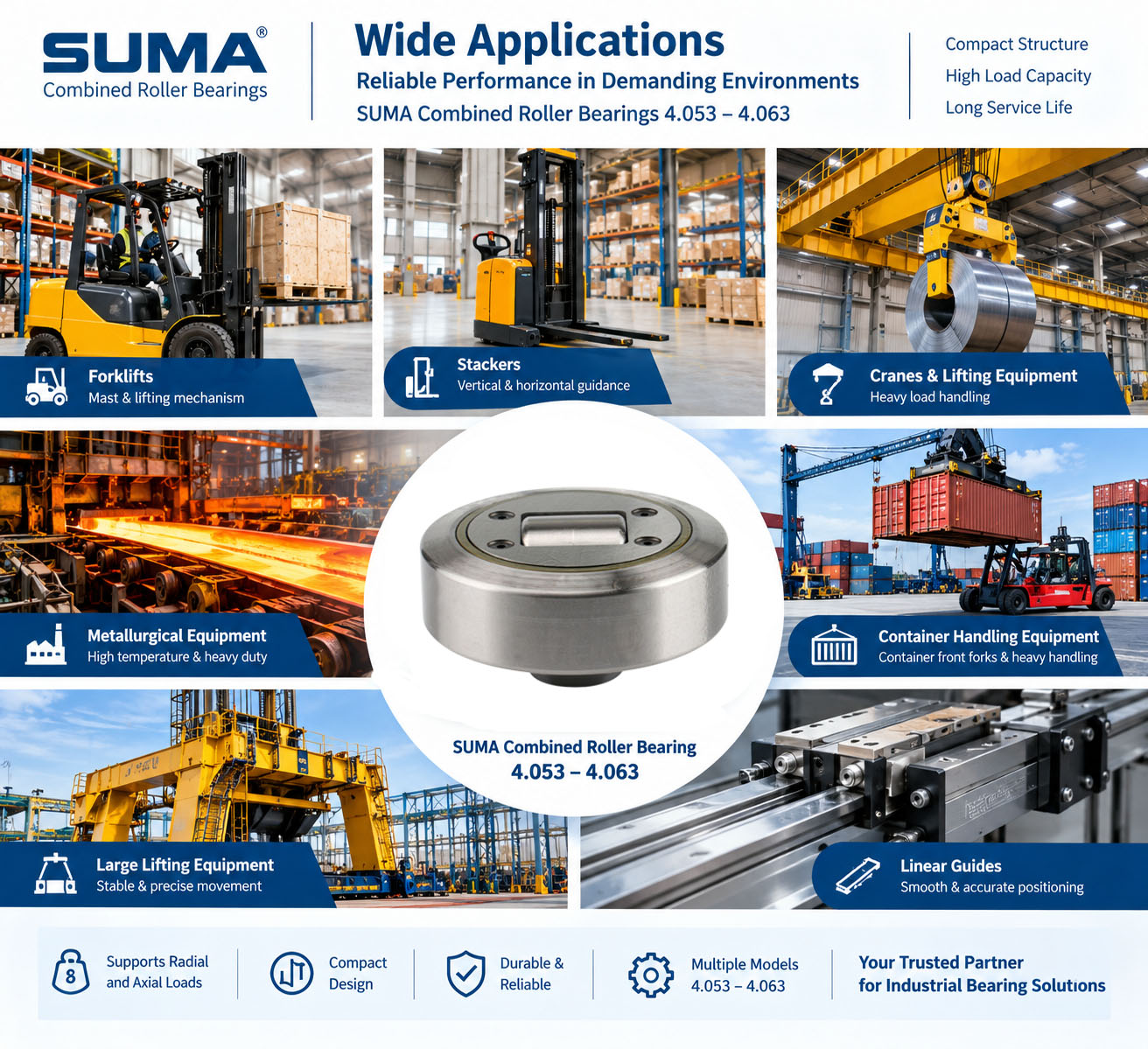
SUMA identifies the 4.053–4.063 combined roller bearings for applications including:
Forklifts
Stackers
Metallurgical equipment
Container front forks
Cranes
Large lifting equipment
Material lifting equipment
These applications are specifically listed in the SUMA technical documentation.
Forklift mast systems are a typical application for combined roller bearings.
The bearing must support the weight of the lifting mechanism while also controlling lateral movement between the moving structure and guide system.
This makes the combined radial/side-load configuration particularly useful.
In the aftermarket, buyers may search for terms such as:
forklift mast bearing
forklift mast roller
forklift carriage roller
combined roller bearing for forklift
forklift guide roller
mast guide bearing
For OEM and replacement purchasing, the exact bearing dimensions and load requirements should be confirmed before ordering.
Stackers and other material-handling machines frequently use vertical or horizontal guided movement.
The bearing system may need to support:
Heavy carriage loads
Repeated movement
Side forces
Frequent start/stop cycles
A combined roller bearing can integrate the radial and lateral support functions into one compact assembly.
Large lifting equipment can generate both vertical and lateral forces.
In these applications, bearing selection should consider:
Maximum lifted load
Load distribution
Guide geometry
Side thrust
Movement frequency
Shock loading
Installation dimensions
A bearing that works for a low-cycle lifting system should not automatically be assumed suitable for a high-cycle crane mechanism.
Steel and metallurgical equipment often operates under demanding mechanical conditions.
The bearing selection should therefore consider the actual operating environment in addition to load and dimensions.
For replacement enquiries, providing the existing bearing model, drawing or dimensions allows the supplier to check the mechanical compatibility before quotation.
The main engineering advantage is functional integration.
A conventional system may require separate components for:
Radial support
Lateral guidance
Mounting
Adjustment
A combined roller bearing integrates several functions into a compact bearing arrangement.
According to the SUMA documentation, this construction can reduce space and manufacturing costs while providing relatively large radial and axial bearing capacity. The accessories are also described as highly replaceable.
This can be particularly valuable for OEM machinery where installation space is limited.
One important distinction in the combined bearing family is whether the bearing arrangement allows adjustment.
SUMA's technical documentation states that an adjustable combined roller bearing can adjust the position of the core shaft through an eccentric outer hexagon or eccentric component, allowing adjustment of the axial dimension of the side roller.
This is useful when the equipment requires controlled adjustment between the bearing and guide system.
However, the 4.053–4.063 article should be positioned primarily around this specific series, rather than mixing it with the separate 4.454–4.464 adjustable series.
For buyers looking specifically for adjustable versions, SUMA can provide a separate product page covering the relevant adjustable models.
A combined roller bearing is a bearing assembly designed to support loads in more than one direction. The SUMA design incorporates main rollers, side rollers and shaft heads installed in different directions.
SUMA specifies the 4.053–4.063 series for forklifts, stackers, metallurgical equipment, container front forks, cranes and large lifting/material-handling equipment.
A conventional roller bearing is generally optimized around a primary load direction. A combined roller bearing is designed to provide radial and lateral/axial support within one compact arrangement.
The SUMA 4.058 has a listed outside diameter of 88.4 mm, 45 mm bore, radial dynamic load rating of 68 kN, radial static load rating of 72 kN and axial static load rating of 23 kN. Its listed maximum speed is 750 rpm.
The 4.063 is the largest model in the supplied 4.053–4.063 technical table. It has a listed outside diameter of 149 mm, 60 mm bore, radial dynamic load rating of 151 kN and radial static load rating of 192 kN.
Compare the required shaft diameter, installation dimensions, radial load, side load, operating speed and actual machine configuration. The models have different dimensional envelopes and load ratings.
Yes. For a replacement project, provide the existing part number, dimensions, drawing or photographs together with quantity and application. This allows the required model to be checked before quotation.
Yes. Forklifts are one of the applications specifically identified in the SUMA technical documentation.
The SUMA documentation lists cranes and large lifting equipment as applications. Actual suitability depends on load, side force, movement cycle and installation conditions.
Yes. For OEM projects, it is recommended to provide the drawing, annual quantity, application conditions and required delivery market so the bearing can be evaluated for the complete system.
For OEM projects, a drawing or complete bearing designation is strongly preferred.


